
How to Plan Medical Coverage for Large Events: A Complete Guide
Large events bring large crowds — and large crowds bring medical risk. Whether it’s a 5,000-person charity run or a 100,000-attendee music festival, event organizers are legally and ethically responsible for providing adequate medical coverage. The question isn’t whether you need medical planning — it’s how to do it right.
This guide covers the key factors in planning medical coverage for large events, from risk assessment to infrastructure to staffing.
Start With a Medical Risk Assessment
Every event medical plan starts with understanding your risk profile. The variables that matter most are attendance size, event duration, weather exposure, crowd demographics, and activity type. A summer outdoor concert with alcohol service has a very different risk profile than a corporate conference in a convention center.
Key questions to answer: How many people will attend each day? What is the age range? Will there be physical activity (running, dancing, sports)? Is alcohol being served? What are the expected weather conditions? How far is the nearest hospital? These answers drive every other decision in your medical plan.
Determine Staffing Levels
Industry standards from the National Association of EMS Physicians (NAEMSP) provide guidelines for medical staffing at mass gatherings. As a general rule, events with over 10,000 attendees should have at least one physician on-site, multiple paramedics, and a team of EMTs. Smaller events may require only EMTs and first responders, but always err on the side of more coverage.
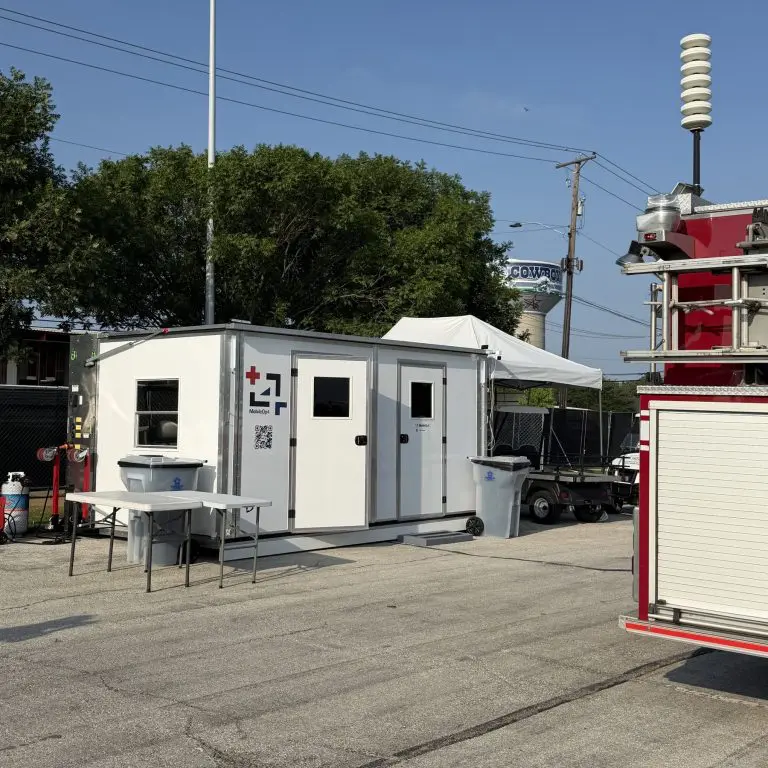
Don’t forget that your medical staff needs somewhere to work. A mobile medical unit gives your team a climate-controlled, equipped workspace rather than an open tent with a folding table.
Choose the Right Medical Infrastructure
The days of setting up a canopy tent with a cooler of ice packs are over. Modern event medical coverage requires proper infrastructure: climate control (especially for hot-weather events), lighting, electrical power, ADA accessibility, and actual medical equipment beyond a first aid kit.
Event Modules provides purpose-built mobile medical units that include all of these features. Our units deploy in under 15 minutes and give medical staff a professional environment to assess and treat patients. For hot-weather events, adding a cooling and hydration station can dramatically reduce heat-related incidents before they become medical emergencies.
Plan Your Medical Footprint
Where you place medical stations matters as much as how many you have. Medical units should be positioned based on crowd density, distance from high-risk areas (stages, athletic courses, food/drink service), and accessibility for ambulance ingress/egress. For large venues, consider multiple stations so no attendee is more than a 3-5 minute walk from medical care.
A command and control post positioned centrally can coordinate all medical operations, track patient volume across stations, and communicate with local EMS if a transport is needed.
Address Heat and Weather Risks
Heat-related illness is the number one medical issue at outdoor events. Dehydration, heat exhaustion, and heat stroke can escalate quickly in large crowds where shade is limited and physical activity is high. Proactive heat mitigation — not just reactive treatment — should be part of your plan.
This means providing shaded cooling areas, free water stations, and cooling modules where attendees can recover before a minor issue becomes an emergency. Events in the southern U.S. or during summer months should treat heat planning as a primary concern, not an afterthought.
Have a Mass Casualty Incident Plan
No one wants to think about worst-case scenarios, but responsible event planning requires it. A mass casualty incident (MCI) plan outlines how your medical team responds if the number of patients exceeds normal capacity — whether from a crowd crush, severe weather, or other emergency.
Your MCI plan should include triage protocols, communication chains, hospital transport coordination, and — critically — the infrastructure to handle multiple patients simultaneously. A mass casualty station provides the multi-patient triage capability that standard medical tents simply cannot.
Document Everything
Thorough documentation protects both your attendees and your organization. Every patient encounter should be logged with time, chief complaint, treatment provided, and disposition. This data serves two purposes: it demonstrates due diligence for liability protection, and it gives you historical data to improve medical planning for future events.
Start Planning Early
Medical coverage should be one of the first logistics items on your planning timeline, not one of the last. Booking medical units, hiring staff, and coordinating with local EMS all take time. We recommend beginning your medical planning at least 8-12 weeks before your event date.
Need help planning medical coverage for your next event? Contact Event Modules for a consultation. We’ll help you assess your needs and build a medical infrastructure plan that keeps your attendees safe and your organization protected.